 THE STANDUP
 CTXWINDOW
 AGENTWIRE
 BLOCKDEX
 COMPOUND
 USINGITUP
 TRUSTDESK
 QuorumFileAug 22, 20263 min read
QuorumFile asks whether HUD's deadline applies to your agency, because HUD's own published files cannot answer that
An executive director at a small public housing authority is told to rewrite a policy document, put it out for public notice, run a hearing, and get a board to adopt it before January 1, 2027. Two categories of agency are excused from that work entirely. The director has no way to look up which category the agency is in, and neither does anybody selling help.
QuorumFile writes that policy chapter and the whole adoption record behind it: the public notice, the resident advisory board memo, the hearing script, the board resolution, and the dated adoption memo. Before any of that, it asks three questions.
Two exemptions, and no roster for either
HUD Notice PIH 2026-15, issued 14 May 2026, exempts agencies in HUD's Moving to Work demonstration and agencies that file their tenant forms exclusively through HUD's own Family Reporting Software. Both sound like lookups. Neither is.
| What we would need to know | What HUD publishes | What QuorumFile does |
|---|---|---|
| Is this agency in Moving to Work? | A map layer of 41 participant codes, last updated 2018, with none of the later expansion cohorts | Excludes those 41, then asks the reader anyway |
| Does it file only through HUD's software? | Nothing. There is no list. | Asks. It cannot be determined from any public file. |
| Is it small enough to skip the annual plan, so the 75-day submission date does not apply? | Voucher counts and troubled status are not in the roster file the agency list is built from | Asks, and only then computes that date |
Answer yes to either exemption and the free Decision Sheet says so and stops computing dates. It does not print a countdown to a deadline that may not be the reader's.
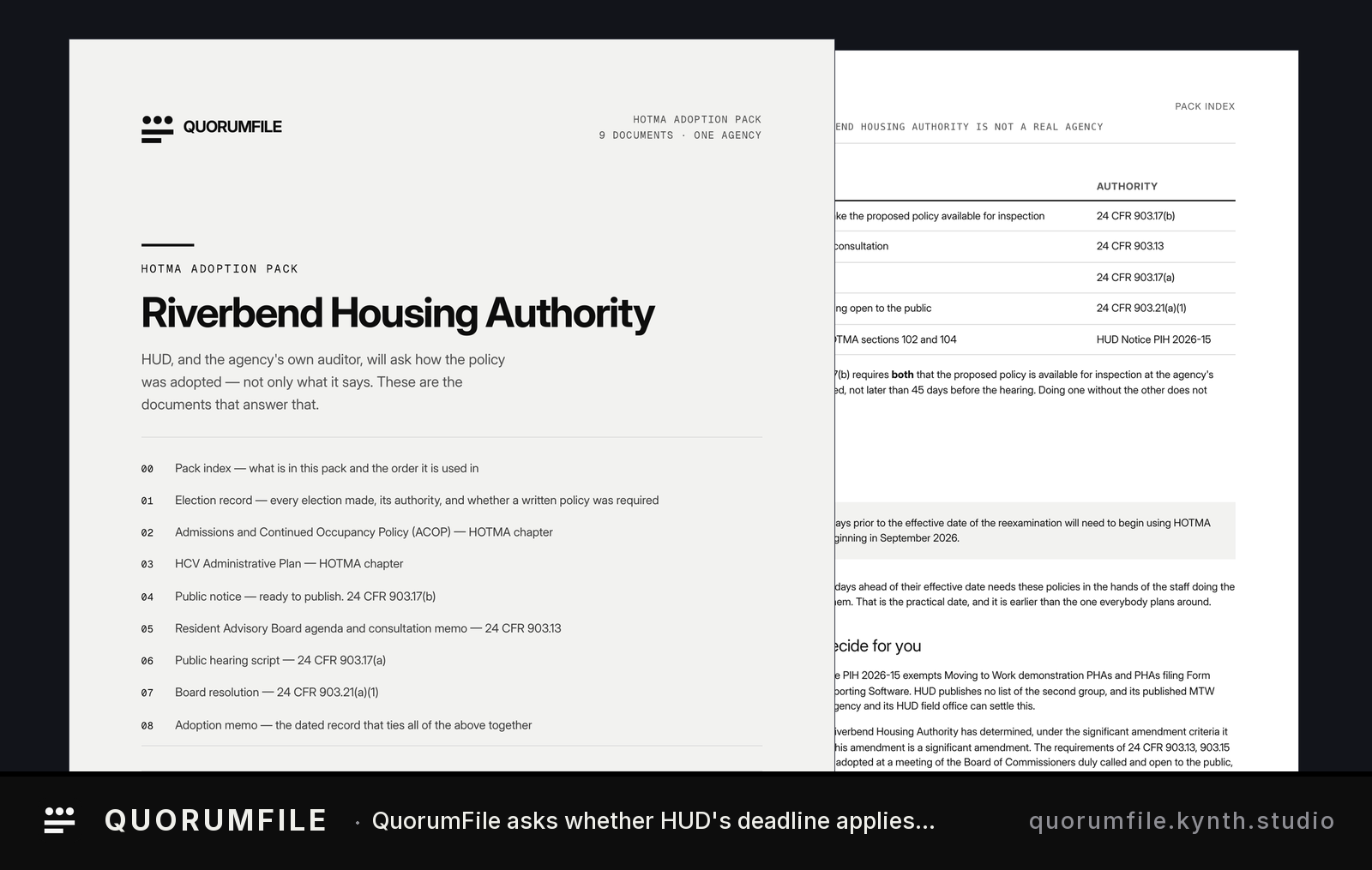
The paid generator refuses too
The pack builder has five gates, and each one throws rather than produce a document. An agency that reported exempt status gets nothing until a person writes a review file explaining whether the exemption actually holds. An unknown program type stops the build, because guessing between the two policy documents either shorts the customer one or invents one the agency does not run. An election left undecided stops it: a chapter with an unmade election in it is not a chapter. An election whose chosen option needs a dollar threshold or a number of days, with no figure supplied, stops it: a policy with a blank threshold in it is not a policy.
The fifth is the one that saves real money. 24 CFR 903.17(b) requires the notice published and the proposed policy available for inspection no later than 45 days before the hearing. If that date has already passed, the notice this pack would print is non-compliant on the day it comes out of the printer, and the agency finds out after the hearing.
What the buyer gets
Seventeen HOTMA elections, each with its citation and the regulation's own words beside it, three of which the regulation requires a written policy for. The free sheet and the paid chapter read the same catalogue file, so a citation cannot say one thing in the free artifact and another in the one that was paid for. The sheet needs no account. The pack is a flat fee charged once, from $99 for a single policy document and $199 for an agency that runs both.
When the 45-day gate fires, it names the date the notice should have gone out and the earliest hearing date that still works.
How we built it: QuorumFile
---
One shipped product, taken apart, once a month. What it does, what it cost to build, what the pipeline behind it looks like, and what the numbers did, read off the repository and the live site, not written from memory. Join the list.