 THE STANDUP
 CTXWINDOW
 AGENTWIRE
 BLOCKDEX
 COMPOUND
 USINGITUP
 TRUSTDESK
 KitGradeAug 31, 20264 min read
No paid starter kit can earn 30 of KitGrade's 100 points, because you cannot see whether anyone is still working on it
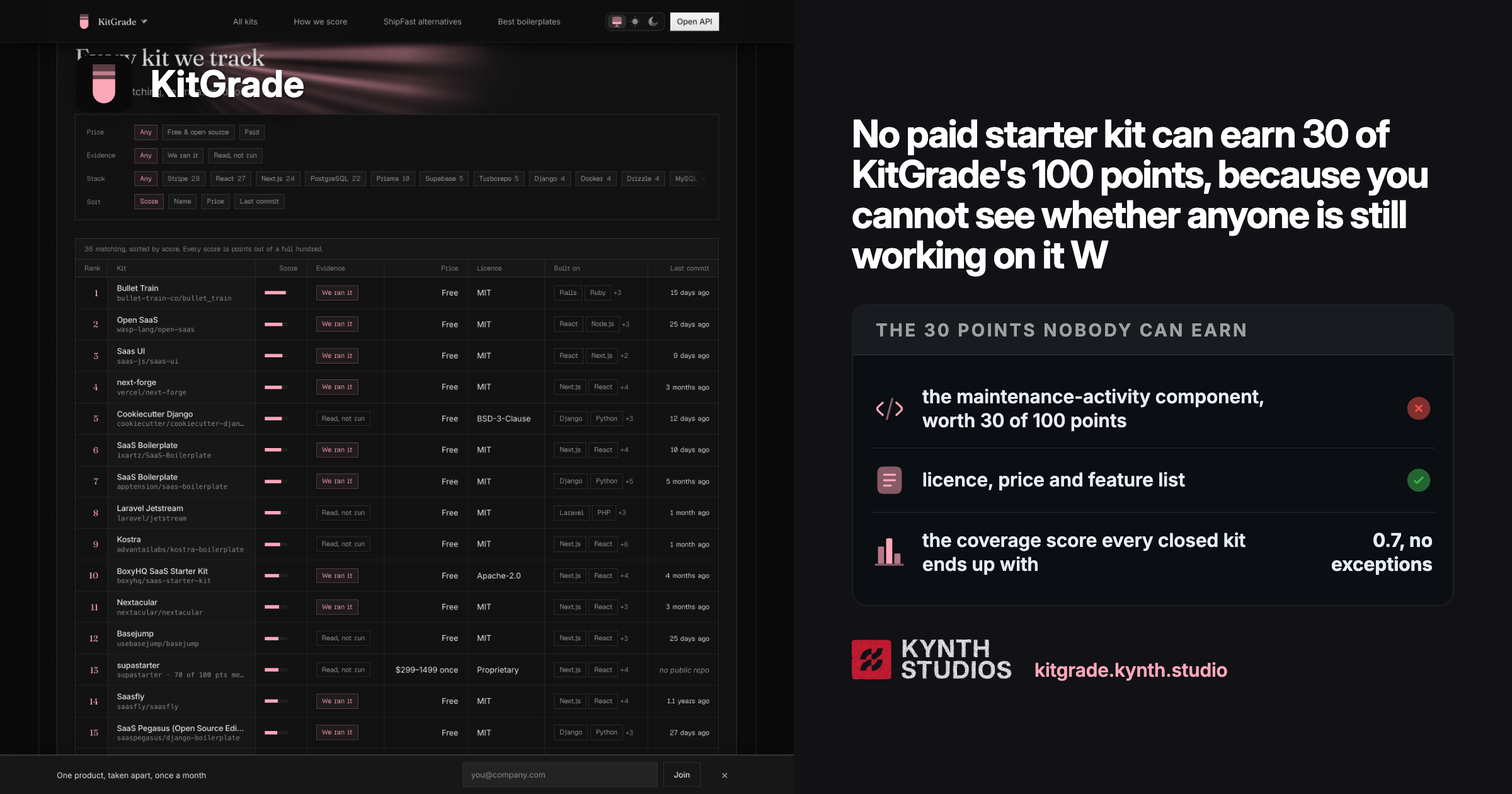
When you pay for a starter kit, the one thing you cannot check first is whether anybody is still working on it. The licence is on the page. The price is on the page. The feature list is on the page. The history of the code is not, because there is no public source for it to sit in.
That gap is worth 30 points out of 100 on our board, the largest single component of the score. Every closed kit we list carries the same coverage figure, 0.7. Seventy of the hundred points were observable on some public surface. Thirty were not, and the same thirty every time.
What KitGrade is
KitGrade is a directory of SaaS starter kits scored from measured facts. It is for the developer about to spend a few hundred dollars on one and wanting something other than the vendor's own review of itself. Each kit gets a page carrying its score out of 100, the five components broken out, and the page or the sentence every single figure was read from. Kits we cloned and ran also carry the transcript of that run, every command, its exit status, and how long it took. Reading it is free, being listed on it is free, and there is no advertising and no paid placement, so no part of a score can be bought.
The five components, and where each one comes from
| Component | Points | What it is read from | A kit with no public source code |
|---|---|---|---|
| Maintenance | 30 | Date of the last commit, tagged releases in twelve months, contributor count | Nothing to observe, so it is marked unmeasured |
| Completeness | 25 | Dependency manifests and the file tree, or the vendor's own feature pages | Read from the vendor's pages, and labelled as the weaker signal |
| Transparency | 20 | Public source 6, stated licence 4, price readable without an account 4, release history 3, docs 3 | Measured, and the 6 for public source go unearned |
| Documentation | 15 | A docs site is 7, plus up to 8 more for how many pages its index links | Measured |
| Support | 10 | A private or priority channel stated publicly is 10, a community channel is 6 | Measured |
Dividing by what you could measure
The tidy fix for an unmeasured component is to score the kit out of the points that were available, so a closed kit is not marked down for being closed. That figure exists, it sits on every kit page beside the score, and it does not set the order. A kit whose upkeep cannot be checked really is a worse purchase than an identical kit whose upkeep can, and dividing that away puts the least checkable kits at the top of a table built to correct exactly that. The top of the board is a free MIT kit at 92.2.
Running them is a separate fact from scoring them
On the pass of 2026-08-31, every listed kit with a JavaScript package manifest was cloned onto a machine and given the install its own files call for, seventeen of them. Eleven installed from a clean clone. Three then built with no configuration at all: create-t3-turbo, precedent and saas-pegasus-oss.
None of that moves the score. Whether a kit builds before you have set a single environment variable is published on its page as its own fact and feeds no component, because needing a database first does not make a kit worse. A paid kit cannot be cloned at all, so it stays labelled documented until its vendor sends a review copy, and whether one was asked for and what came back is printed on the page either way.
Every score, with the page each figure was read from: https://kitgrade.thecompound.tech/hn
---
One shipped product, taken apart, once a month. What it does, what it cost to build, what the pipeline behind it looks like, and what the numbers did, read off the repository and the live site, not written from memory. Join the list.