 THE STANDUP
 CTXWINDOW
 AGENTWIRE
 BLOCKDEX
 COMPOUND
 USINGITUP
 TRUSTDESK
 KitGradeAug 23, 20263 min read
KitGrade reads a starter kit's price off the vendor's own page, and most dollar figures on that page are not prices
You are choosing which SaaS starter kit to buy. Two of them look about a hundred and fifty dollars apart, so you pick the cheaper one, and the checkout asks for $299. The low figure you were comparing was a sixty minute consulting call sold further down the same page.
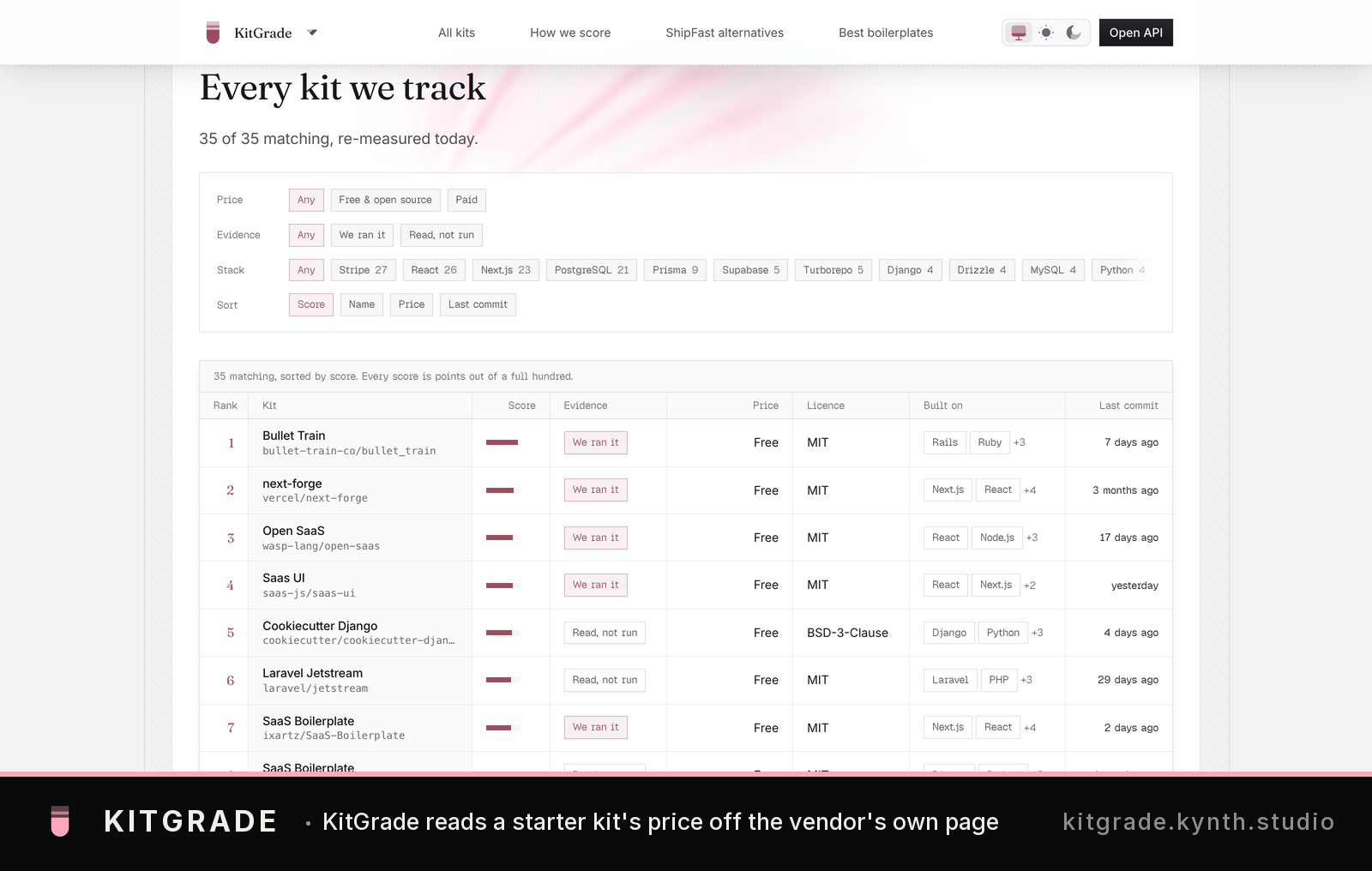
KitGrade is a directory of SaaS starter kits scored from measured facts. Every price on it is read off the vendor's own pricing page and published with the sentence it was read from, so the buyer can check the reading rather than trust it. The hard part is that a pricing page carries far more dollar figures than it has prices.
Watch the KitGrade, SaaS starter kits, scored from measured facts. demo
Four ways a page offers a number that nobody pays
A crossed-out original is the commonest one, and the only evidence that it is crossed out lives in the markup that gets deleted when HTML becomes text. Shipixen's lifetime tier, fetched 2026-08-13, flattens to "$500 $379": two adjacent figures with nothing between them and no signal about which one anyone pays. Guessing a rule would be wrong on a genuine two tier row like "$249 $379". So a line-through run gets the word "was" put in front of it before the tags are stripped, which the reject list already handles, and it reads correctly in the quoted evidence too.
A worked example is the subtlest. SaaS Pegasus explains its upgrade fee in a FAQ as $999 minus $449 plus $49 equals $299. Neither $49 nor $299 is the price of anything a buyer can purchase. That is caught as arithmetic rather than by keyword: a figure whose entire gap to the adjacent figure is an operator is an operand or a result, never a tier. The prose half needs its own rule, because "plus $49" appears before the symbols do. The word plus in front of a figure makes it an addend. Behind it, as in "$449 plus tax", it leaves a perfectly good price.
Then a service sold beside the kit, and a discount sticker. Both are real prices of something, and neither is a price of the thing being ranked.
The words that disqualify a figure are bounded by the nearest dollar sign on each side. The window that gets quoted on the page is much wider, and is never tested against. Keeping those two jobs apart is why a "$121 off" badge disqualifies 121 and leaves the tiers next to it alone.
| vendor page, when read | the figure | what it actually is | what KitGrade publishes |
|---|---|---|---|
| supastarter.dev, 2026-08-14 | $149 | a 60 minute consulting call, "Book call" | $299 to $1,499, the three one-time tiers |
| saaspegasus.com, 2026-08-14 | $49 and $299 | operands in an FAQ upgrade example | $449 to $499, Unlimited on sale from $999 |
| shipixen.com, 2026-08-13 | $500 and "$121 off" | struck-through original, promo badge | $249 yearly and $379 lifetime |
| larafast.com, 2026-08-15 | none readable | a 1,486 byte block page, /pricing 404s | no price, and the page states the refused fetch |
That last row stays empty on purpose. A price is worth 4 of the 20 transparency points in a 100 point score, and an unreadable vendor page is reported as the measurement it is, never as a vendor withholding a price.
The label above every score says the same kind of thing. Hands-on means the kit was cloned and its own install and build were run with the transcript on its page. Documented means the repository, pricing page and docs were read and nothing more. Of the 35 kits, 15 are hands-on and every one of the 14 paid kits is unrun, because a paid kit cannot be installed without buying it.
Free to read, free to be listed, no affiliate links and no paid placement: KitGrade.
---
One shipped product, taken apart, once a month. What it does, what it cost to build, what the pipeline behind it looks like, and what the numbers did, read off the repository and the live site, not written from memory. Join the list.