 THE STANDUP
 CTXWINDOW
 AGENTWIRE
 BLOCKDEX
 COMPOUND
 USINGITUP
 TRUSTDESK
 CoverCheckSep 5, 20263 min read
Nothing on a vendor's certificate records whose insurer pays first, and CoverCheck refuses to mark that line green
When two insurance policies both answer for the same accident on your property, one of them pays first and the other sits behind it. The sentence that decides the order has nowhere to live on a vendor's certificate of insurance. It is either typed into the free-text block at the bottom of the page by whoever was at the agency that morning, or it is absent, and absent looks identical to an agency that simply didn't type it.
The industry term is primary and non-contributory. IRMI defines it as "a term commonly used in contract insurance requirements to stipulate the order in which multiple policies triggered by the same loss are to respond." Boards write it into their vendor agreements. The standard certificate has no field that records whether they actually got it. CoverCheck, vendor insurance tracking for small property and HOA management companies, refuses to mark that line green.
Watch the CoverCheck, Certificate-of-insurance tracking for property and HOA managers demo
What CoverCheck is
A manager uploads a vendor's certificate; CoverCheck reads the carrier, limits, endorsements and dates, checks them against that community's requirements, flags what is short or expiring, and drafts the chase email to the vendor's insurance agent. The manager approves, edits or skips every draft before anything sends. $15 a month, flat, unlimited vendors and communities.
It is for the person at a management company holding forty vendors across nine associations in a spreadsheet, with a board meeting on Thursday. What they get is a page per community listing every vendor with what is missing from each certificate, a chase thread per shortfall, and a re-check that runs overnight, because a certificate that was fine yesterday can be expiring today.
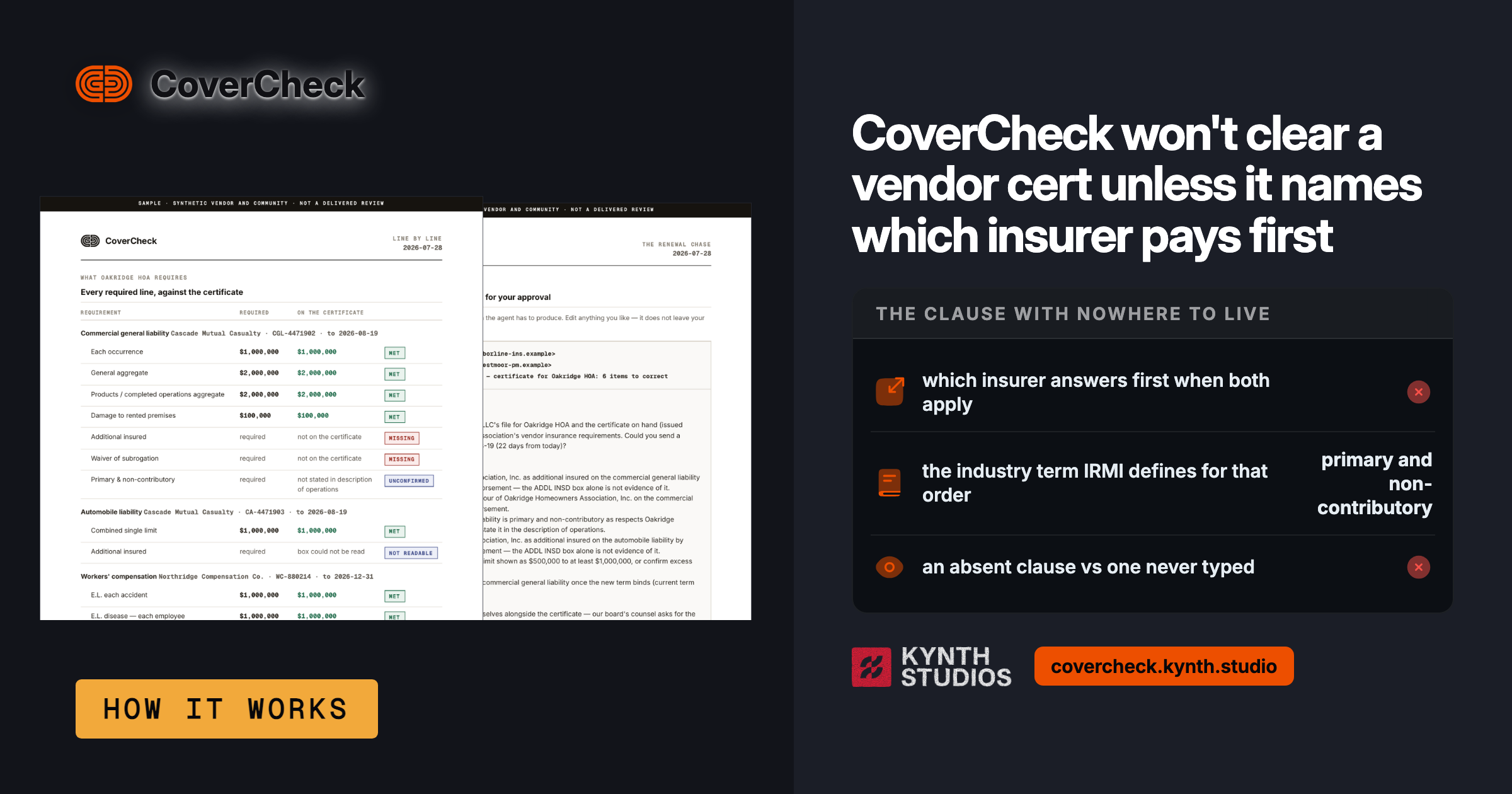
Confirmable presence, unprovable absence
Two of the three endorsements a board asks for do have a tick column on the certificate. Even those columns only assert the thing; the endorsement document is what creates it. The third has no column at all, so our checker can confirm it is present and can never confirm it is missing. It writes a review item every time, and a review item outranks a pass.
| What the association asked for | Where it is recorded on the certificate | What CoverCheck writes when it is not there |
|---|---|---|
| Association named as additional insured | A tick column | Blocked if the column reads no. Sent to a person if the column can't be read. |
| Waiver of subrogation | A second tick column | Blocked if the column reads no. Sent to a person if the column can't be read. |
| Primary and non-contributory | No column. Free text at the bottom, if anywhere | Always sent to a person, never blocked, never green. |
The same rule runs everywhere else in the checker. An unreadable limit box is a review item, not a score. A certificate that couldn't be read at all writes no verdict row and shows the vendor under "waiting on a human". Twenty-five tests hold that behaviour in place, and four of them exist only to prove an unreadable field never turns into a tick.
A manager is putting this in front of a board, and if it ever matters, in front of an adjuster. Green has to mean somebody could read the field.
CoverCheck checks vendor certificates against each community's own requirements and drafts the chase email when one falls short.
---
One shipped product, taken apart, once a month. What it does, what it cost to build, what the pipeline behind it looks like, and what the numbers did, read off the repository and the live site, not written from memory. Join the list.