 THE STANDUP
 CTXWINDOW
 AGENTWIRE
 BLOCKDEX
 COMPOUND
 USINGITUP
 TRUSTDESK
 CivicBinderAug 22, 20263 min read
CivicBinder Health writes one repair line per PDF on a practice's website, and use outranks the filename year
A patient books a first appointment and is told to fill in the new-patient form before they arrive. The form is a PDF. The software that reads a web page aloud opens it and finds no fields it can announce and no order to read them in. So the patient phones the front desk and reads their insurance number and their medications to a receptionist, in a waiting room, out loud.
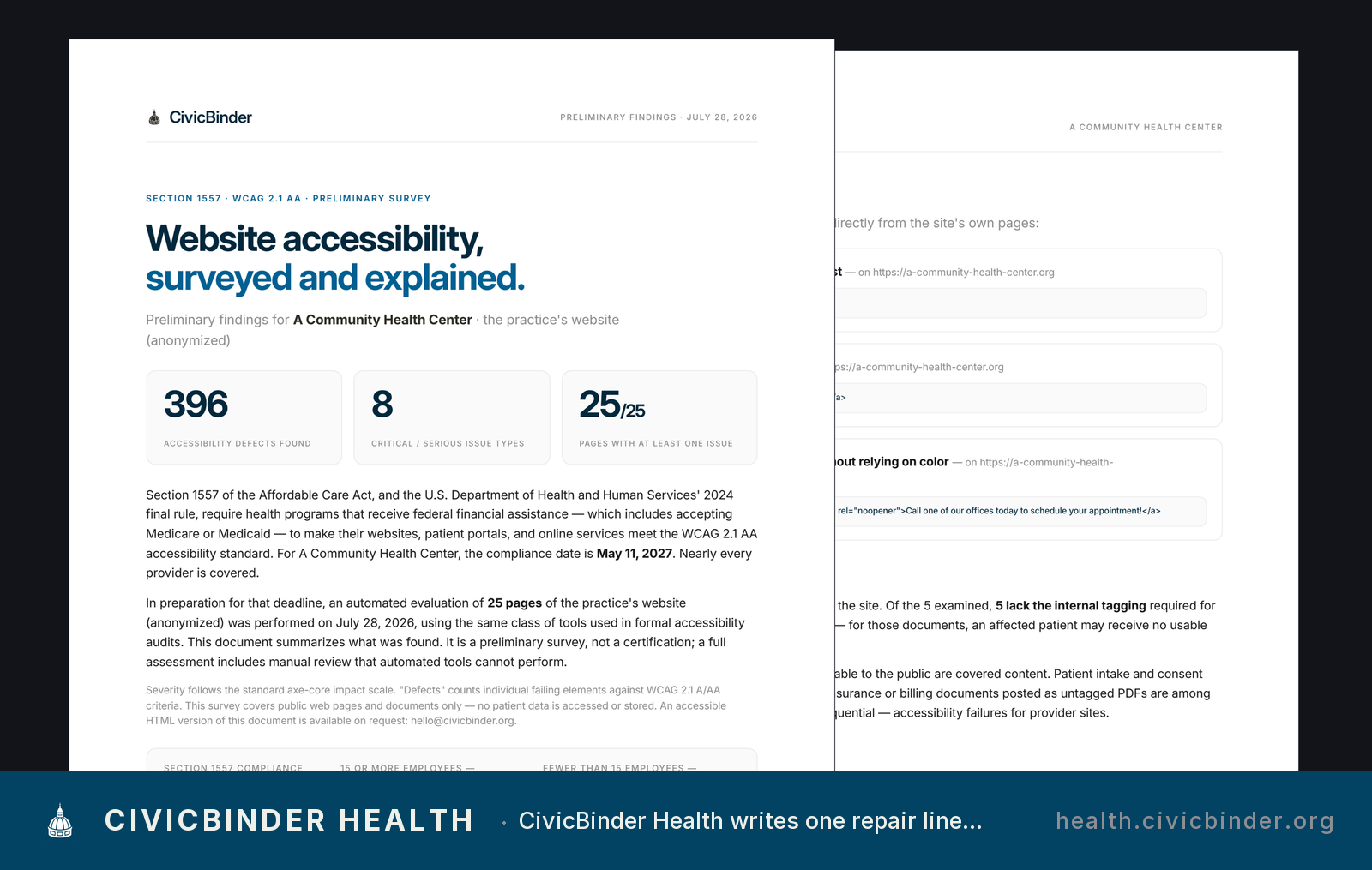
CivicBinder Health crawls a practice's public website, downloads every PDF it links to, examines each one, and produces a Section 1557 Readiness Binder: the accessibility evaluation, a complete document inventory, a Notice of Nondiscrimination and Accessibility Policy prepared for the practice to adopt, a public accessibility statement, and a dated remediation plan the practice's web vendor can execute.
The interesting part is Section 2, the inventory, because every row of it ends in an instruction, and something has to decide which instruction.
Watch the CivicBinder Health demo
Age is the last question, not the first
45 CFR 84.85(b) excepts documents that were already posted before the compliance date, unless they are currently used to apply for, gain access to, or participate in the program. A new-patient form named intake-2019.pdf, still linked from the appointments page, is squarely in scope. The year in its name says nothing about whether anyone is filling it in this morning.
So the check for what a document is for runs ahead of the check for how old it looks. The year test only ever sees the documents that the use test declined to claim. Get that order backwards and the single most consequential file on a small practice's site gets written up as an archive candidate, and the vendor never touches it.
What counts as accessible
Two conditions, both required: the file declares itself structured, and it actually carries the structure. A PDF that claims the first while failing the second is common, and it is the exact case where a manual glance says fine. Either condition missing marks the row Untagged.
| What the checker finds | What the binder tells the vendor to do |
|---|---|
| The file will not download or will not parse | Re-export from source; file is unreadable as posted |
| Declared structured and carries structure | Verify reading order and image alt text at next update |
| Name matches form, intake, consent, registration, hipaa, notice, authorization, new-patient, insurance | Active patient form, rebuild as an accessible HTML form or tagged fillable PDF |
| Name carries a year from 2010 to 2024 | Archive candidate, provide accessible version on request |
| Eight or more pages | Regenerate from the source document with tagging enabled, do not rescan |
| Anything else | Re-export from source with tagging enabled |
That fifth row is a judgment about cost. Past roughly eight pages, running the printed file back through a scanner is slower and worse than going back to the original document, so the binder says so instead of leaving the vendor to find out.
What it costs, and what it will not do
The preliminary scan is free. The Readiness Binder is $299 one time for a single-location practice and $499 for a larger organization, with a quarterly re-scan at $19 a month. Compliance dates are May 11 2027 for practices with 15 or more employees and May 10 2028 for smaller ones.
The scan reads public web pages only, downloads at most 25 documents at up to 15 MB each, stores no patient data, and is described in its own cover note as a preliminary survey rather than a certification.
Run yours: https://health.civicbinder.org/kd?utm_campaign=compound
---
One shipped product, taken apart, once a month. What it does, what it cost to build, what the pipeline behind it looks like, and what the numbers did, read off the repository and the live site, not written from memory. Join the list.