 THE STANDUP
 CTXWINDOW
 BLOCKDEX
 COMPOUND
 USINGITUP
 TRUSTDESK
 AgentwireAug 25, 20263 min read
Agentwire opens the license file of every agent tool it indexes, because GitHub reports five of them as "Other"
Your company hires its fiftieth employee. Nothing about the agent framework sitting inside the product you sell changes that week, and the terms it ships under have just started requiring you to...
Your company hires its fiftieth employee. Nothing about the agent framework sitting inside the product you sell changes that week, and the terms it ships under have just started requiring you to buy a commercial license.
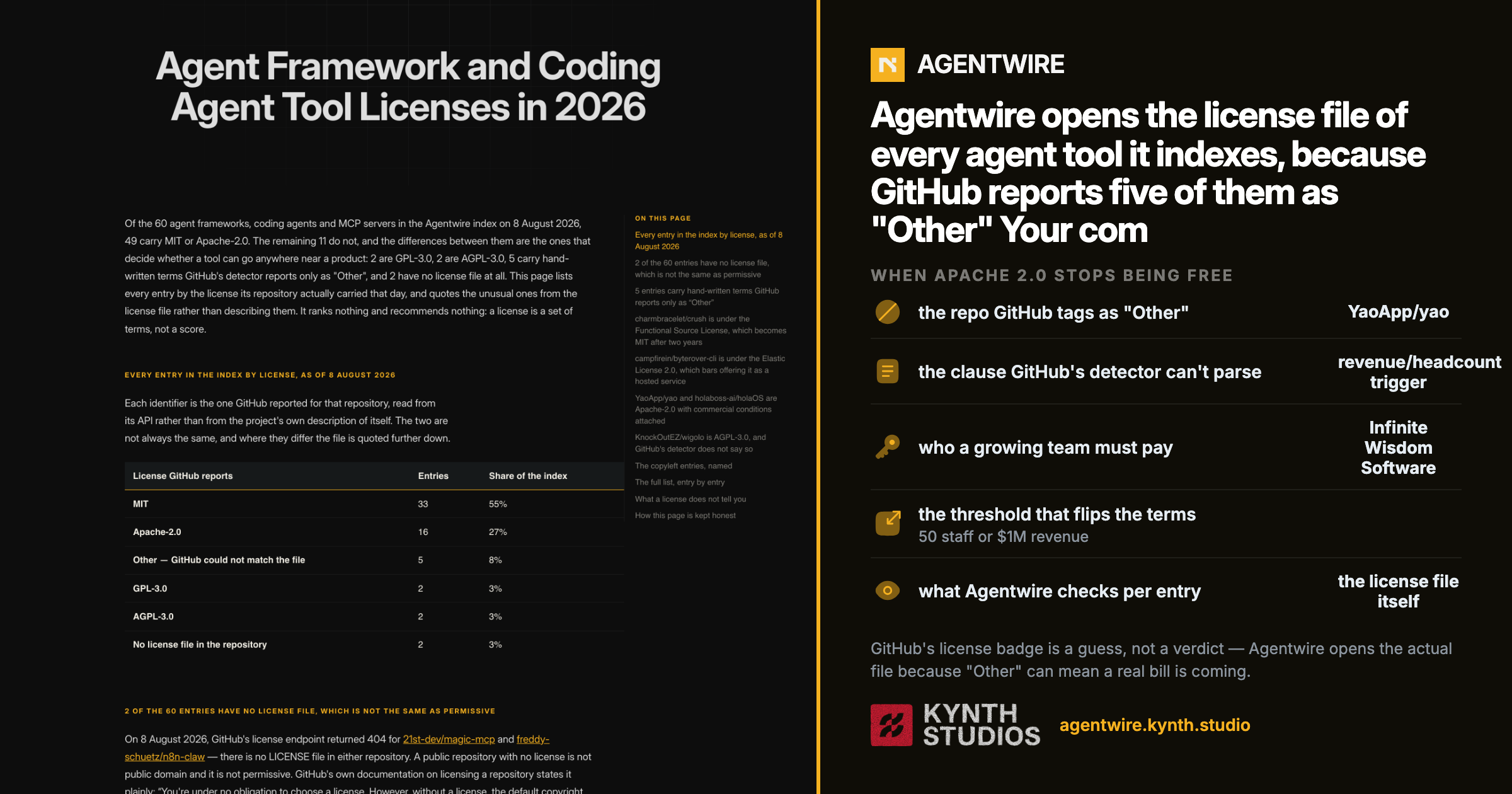
That is YaoApp/yao. Its license file is Apache 2.0 with extra conditions attached, and one of them requires a commercial license from Infinite Wisdom Software for "Organizations with 50 or more employees, or with annual revenue exceeding USD 1,000,000". GitHub's own detector cannot match that file to a known license, so what the repository page reports is the word "Other".
Agentwire indexes agentic developer tooling: MCP servers, coding-agent harnesses, agent frameworks. Every entry credits whoever built the thing and links to their repository. One of its pages lists every entry by the license that repository actually carries, and quotes the unusual ones from the file instead of describing them.
Watch the Agentwire, The index of agentic developer tooling, integrations somebody vouched for demo
Sixty repositories, read on one day
On 8 August 2026 the index held sixty entries. Forty-nine were MIT or Apache 2.0. The other eleven are the ones that decide whether a tool can go near a product: two GPL-3.0, two AGPL-3.0, five reported only as "Other", and two with no license file at all.
The identifiers were asked of GitHub's API for all sixty at once, rather than taken from any project's README. Wherever the answer came back "Other" or empty, the license file itself was downloaded and read. That second step is the whole page. Five files came back, and they contained five different things.
| Entry | What GitHub reports | What the license file itself says |
|---|---|---|
| YaoApp/yao | Other | Apache 2.0 plus conditions: a commercial license above 50 employees or USD 1,000,000 revenue, and the console logo, copyright notice and certificate-verification logic must be preserved |
| holaboss-ai/holaOS | Other | Apache 2.0 plus conditions: no hosted service for third parties and no embedding in anything commercially distributed. Internal use inside one organization is free |
| campfirein/byterover-cli | Other | Elastic License 2.0. "You may not provide the software to third parties as a hosted or managed service" |
| charmbracelet/crush | Other | Functional Source License 1.1 with an MIT future license. Each version converts to MIT two years on, so the terms depend on which release you run |
| KnockOutEZ/wigolo | Other | The GNU Affero General Public License version 3, written out in full under a project title line the detector does not recognise |
The last row runs the other way. Nothing is unusual about wigolo's terms at all, and the honest count of AGPL-3.0 projects in this index is one higher than the identifiers suggest.
The two with nothing
GitHub's license endpoint returned 404 for 21st-dev/magic-mcp and for freddy-schuetz/n8n-claw. No file, in either. GitHub's documentation is plain about what that means: without a license, default copyright applies, "and no one may reproduce, distribute, or create derivative works from your work". Both are public, both can be read and forked, and that is a narrower right than most people take from a public repository.
Those two get their own heading on the page rather than a footnote, because writing "most are permissive" and leaving them inside "most" is the exact failure the page exists to prevent. Nothing on it ranks anything. The words avoid, safe and risky do not appear about anybody's project, and no star count appears either.
An entry only reaches the index when two independent people already vouched for it: a maintainer put it on a list they publish, or a Hacker News thread above forty points points at it, or it cleared the star floor within 120 days of being created. Agentwire has run none of them. It costs nothing, there is no account, and there is nowhere to buy a placement.
Read the index: https://agentwire.thecompound.tech/hn?utm_campaign=compound
---
One shipped product, taken apart, once a month. What it does, what it cost to build, what the pipeline behind it looks like, and what the numbers did, read off the repository and the live site, not written from memory. Join the list.