 THE STANDUP
 CTXWINDOW
 AGENTWIRE
 BLOCKDEX
 COMPOUND
 USINGITUP
 TRUSTDESK
 CertScopeSep 6, 20263 min read
A polyester shirt is exempt from flammability testing and still owes a certificate, and CertScope works out which rules that certificate has to name
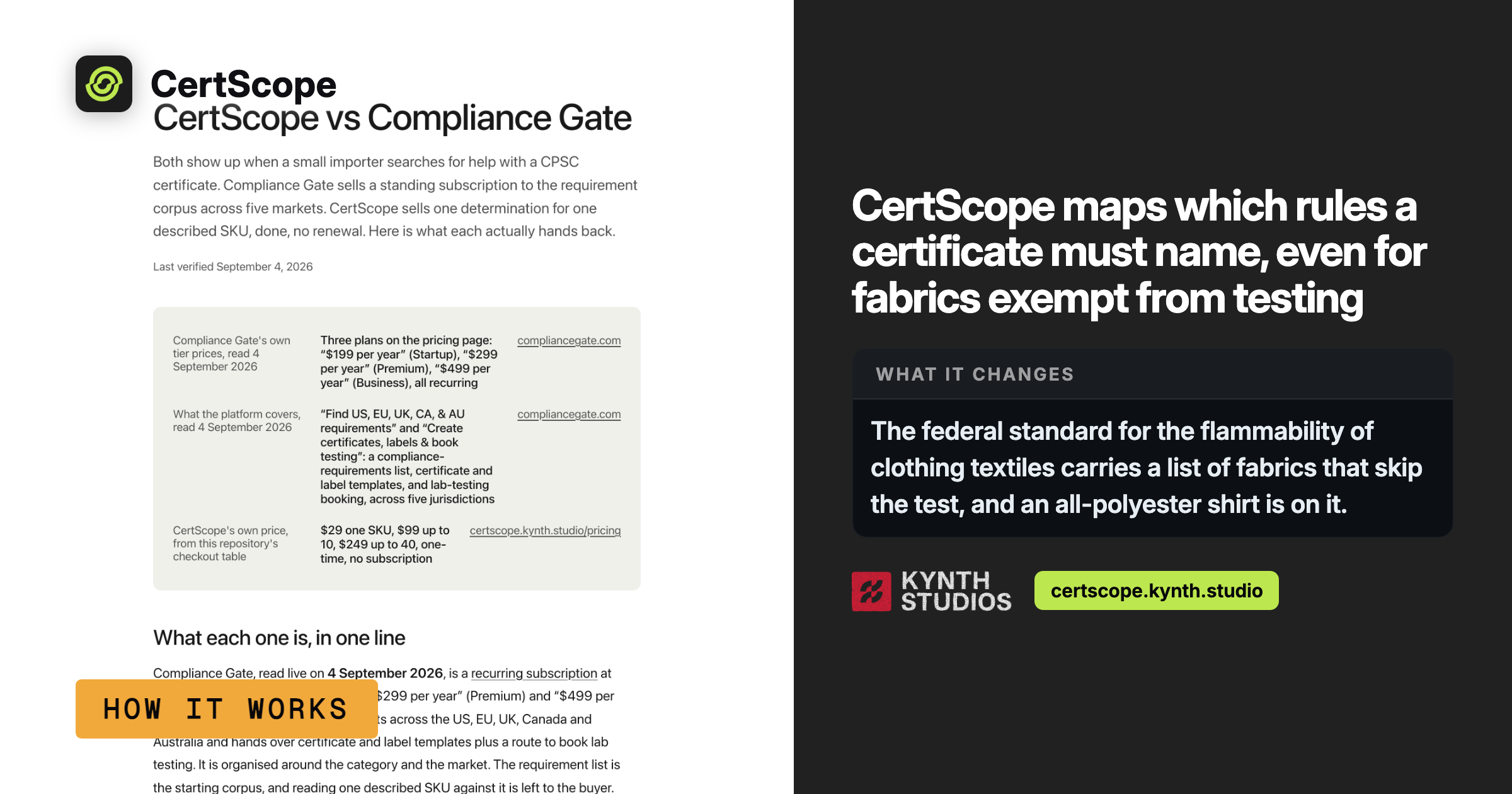
You can be exempt from testing a fabric and still owe a certificate for it. The federal standard for the flammability of clothing textiles carries a list of fabrics that skip the test, and an all-polyester shirt is on it. The text is 16 CFR 1610.1(d), in the eCFR issue of title 16 dated 2026-09-02: firms issuing an initial guaranty of "All fabrics, both plain surface and raised-fiber surface textiles, regardless of weight, made entirely from any of the following fibers or entirely from combination of the following fibers: acrylic, modacrylic, nylon, olefin, polyester, wool" are "exempt from any requirement for testing to support guaranties of those fabrics".
The certificate is still owed, and the exemption adds a line to it. 16 CFR 1110.11(c) says that where a testing exclusion is claimed, the certificate "shall identify the applicable testing exclusion", in addition to listing every applicable rule separately, and in place of the date and place of testing. The seller with the smallest testing bill ends up with the most specific piece of paper. A knowing violation of the certification requirement carries a civil penalty of up to $120,000, and the statute at 15 U.S.C. 2069(d) defines knowingly to include knowledge a person would have obtained by exercising due care.
Watch the CertScope, Which CPSC rules apply to your SKU, determined, certified, broker-ready demo
What CertScope is
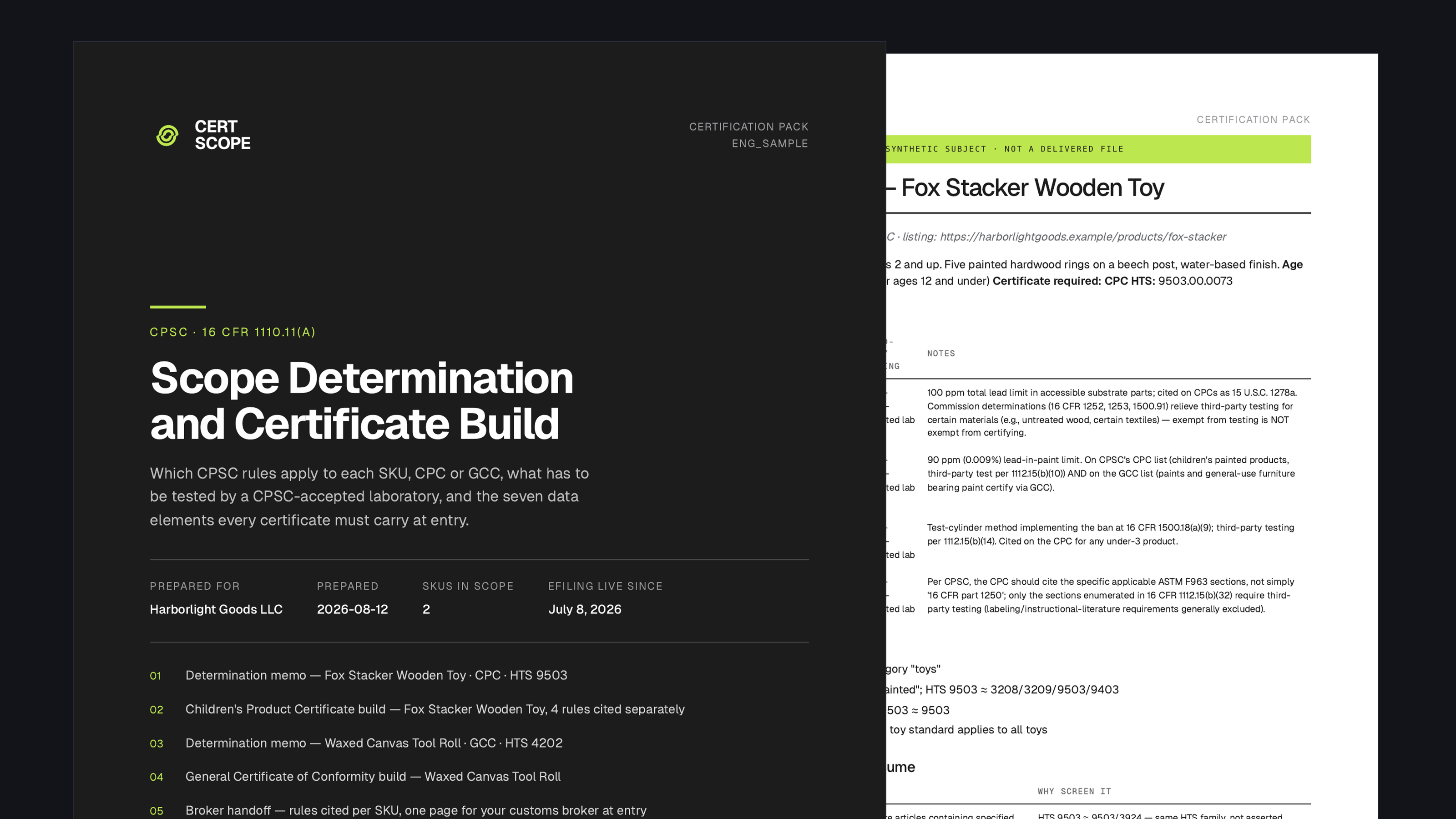
CertScope determines which CPSC rules apply to your SKU and builds the certificate those rules require, in the form a customs broker can file. It is for the importer or brand owner bringing consumer products into the US, and for the seller who has been asked for a children's product certificate and doesn't know which rules it should name. You get a scope determination per SKU, a certificate build, a screen list of the near-miss rules worth checking, an exemption check, and all of it delivered as a PDF and a zip. It costs $29 for one SKU, $99 for up to 10, and $249 for up to 40, one time. Laboratory testing is not included.
Three shirts, three different certificates
| The garment | Testing | Certificate | What it says about testing |
|---|---|---|---|
| Children's apparel | A third party laboratory the CPSC has accepted for this rule | Children's product certificate | The most recent date and place of the test, with the laboratory's contact details |
| Adult apparel, raised-fibre surface, under 2.6 ounces per square yard | Required, and 15 U.S.C. 2063(a)(1) allows a test of each product or a reasonable testing programme, with no accredited laboratory named | General certificate of conformity | Date and place of the test |
| Adult apparel made entirely of polyester | None, under 1610.1(d)(2) | General certificate of conformity, still required | The exclusion, identified by name, in place of the date and place |
What buying a determination does not move
16 CFR 1110.15 lets a certifier rely on another party to run a platform, enter the data, or certify on its behalf, and holds that the certifier "remains legally responsible for the information in a finished product certificate, including its validity, accuracy, completeness, and availability". Paying us does not shift that sentence. CertScope prints it on every result, and every children's-product row it returns is flagged to be confirmed with the laboratory that will run the test. Laboratories quote per test, against a named rule, on a named sample, so the rule list has to be settled before anyone can price the work.
Here is CertScope: https://certscope.thecompound.tech/hn
---
One shipped product, taken apart, once a month. What it does, what it cost to build, what the pipeline behind it looks like, and what the numbers did, read off the repository and the live site, not written from memory. Join the list.